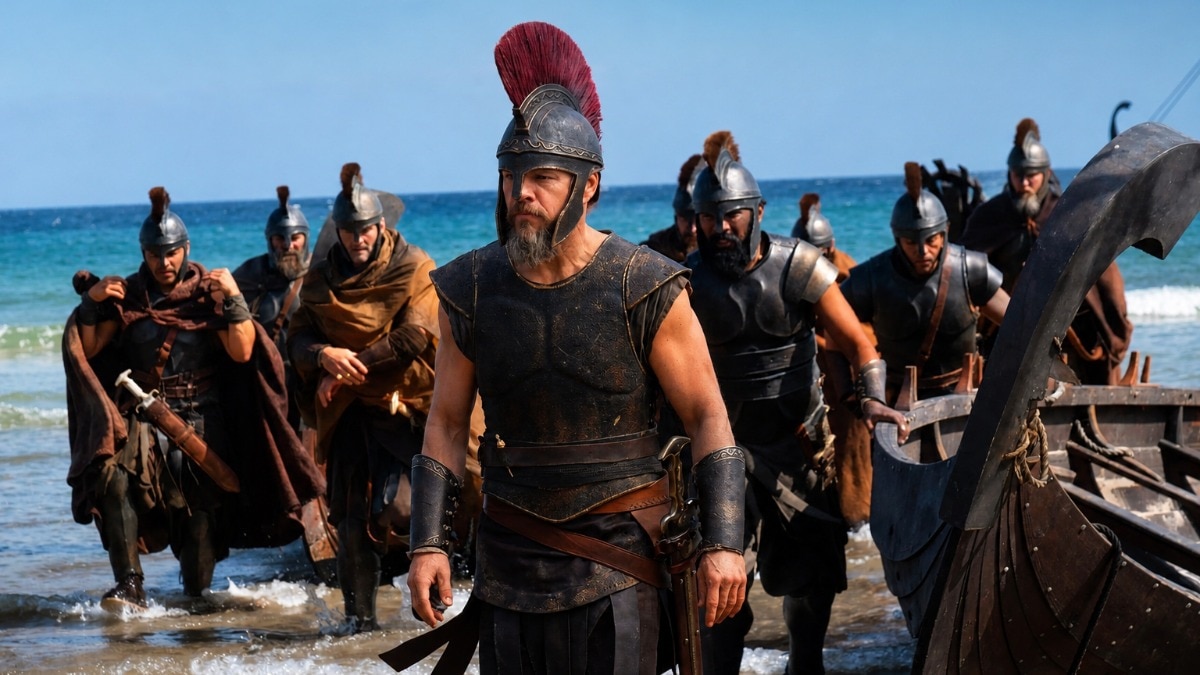
Some films impress you, some entertain you. And then, once in a while, comes a film that reminds you why cinema exists in the first place. Christopher Nolan's The Odyssey belongs to that rare category.
Imagine adapting a literary work that has survived for over 3,000 years into a modern blockbuster. On paper, it sounds almost impossible, but Nolan makes it feel effortless. Clocking in at nearly three hours, The Odyssey never feels like a test of patience. Every chapter of Odysseus' long journey home unfolds like an adventure, balancing spectacle with emotion, mythology with humanity, and large-scale action with deeply personal moments. It is an immersive experience in the truest sense. From the moment the film begins, the world around you almost ceases to exist. You are completely consumed by Nolan's vision, never distracted by what's happening outside the screen.
At the heart of it all is Matt Damon, delivering one of the finest performances of his career. His Odysseus isn't the ideal leader; in fact, the film repeatedly questions his decisions. But what sets him apart is his intelligence, which comes in handy when they escape in the Trojan Horse and later during the army's encounter with the sorceress Circe. Damon portrays a man whose greatest weapons are his intellect and perseverance. The pain, guilt and determination of a soldier desperate to return home shine through his performance.
Just as compelling is Tom Holland. After years of watching him save the world as Spider-Man, audiences get to see an entirely different side of the actor here. He strips away every trace of that superhero confidence to play a young man who has grown up without a father. His vulnerability becomes his greatest strength. One of the film's most moving scenes arrives when Telemachus hears one of Odysseus' old companions speak about his father with admiration and affection. His eyes well up as he quietly thanks the man for helping him know the father he never truly had.
Anne Hathaway brings warmth, resilience and quiet strength to Penelope, embodying the emotional cost of waiting for a husband lost to war. She beautifully captures a woman torn between duty and hope while fighting to protect her family and kingdom. Zendaya, meanwhile, may have limited screen time, but every time she appears, she commands your attention.
Robert Pattinson injects unpredictability into every scene he inhabits, while Elliot Page lends Sinon the quiet emotion of a betrayed soldier. Himesh Patel, too, gets a surprisingly substantial role and holds his own comfortably among some of Hollywood's biggest names. There's also Lupita Nyong'o, Charlize Theron and Jon Bernthal, among others. Despite featuring one of the biggest ensemble casts in recent memory, Nolan ensures every actor has a purpose.
Beyond the spectacle, The Odyssey also becomes an unexpectedly moving reflection on the human cost of war. It isn't merely about kings, monsters and gods. It explores what happens to families when soldiers leave for battle and never know when, or if, they'll return. It also corrodes the souls of those fighting, who slowly lose sight of what home truly means after years of bloodshed and grief.
At the same time, the film remains faithful to its mythological roots. Through Odysseus' journey, Nolan explores Greek mythology, Zeus' divine laws and the consequences of defying the gods, grounding them in deeply human emotions. There are, however, a couple of creative choices that momentarily pull you out of the world Nolan so carefully builds. Hearing Telemachus refer to Penelope and Odysseus as 'Mom' and 'Dad' feels oddly modern for a story set thousands of years ago. It's a tiny detail, but one that briefly breaks the otherwise immersive atmosphere.
Nolan also wisely injects humour into the narrative. One particularly delightful exchange comes during the encounter with the Cyclops, Poseidon's giant son. As the soldiers wonder whether they should attempt negotiating with the towering creature, one of them dryly remarks, "Do you talk to ants?" It's funny, but it also puts humanity's insignificance into perspective when standing before beings of god-like proportions.
If there's one stretch that deserves special mention, it's the film's breathtaking final act. The last thirty minutes are relentless: action, emotion and long-awaited confrontations collide with astonishing precision. Nolan orchestrates the climax with the confidence of a filmmaker operating at the peak of his powers.
Visually, The Odyssey is staggering. Every frame feels meticulously crafted, whether it's the towering Trojan Horse, vast kingdoms carved out of myth, raging seas swallowing entire fleets or battle sequences mounted on an almost unimaginable scale. Nolan creates images that are not merely beautiful but awe-inspiring, proving that spectacle and storytelling need not exist at the expense of each other.
Shot entirely on IMAX cameras, the film constantly reminds you why certain stories deserve to be experienced on the biggest screen possible. Knowing that these cameras can capture only around three minutes of footage before they need to be reloaded makes the film's execution even more impressive. As massive battle sequences, emotionally charged confrontations and technically demanding action scenes unfold with seamless precision, you can't help but wonder how meticulously every frame must have been rehearsed and executed.
Nolan and his team create images that feel monumental without ever losing sight of the characters at their centre. Equally brilliant is the score, which doesn't merely accompany the visuals but breathes life into them, amplifying heartbreak, triumph and suspense with every note.
And that's perhaps what makes The Odyssey so special. It isn't just a film; it's an experience. It's a celebration of storytelling, cinematic craft, technological ambition and Nolan's enduring love for cinema. Few filmmakers working today would even attempt a project of this magnitude. Nolan not only attempts it, but pulls it off with remarkable confidence.
Some films impress you, some entertain you. And then, once in a while, comes a film that reminds you why cinema exists in the first place. Christopher Nolan's The Odyssey belongs to that rare category.
Imagine adapting a literary work that has survived for over 3,000 years into a modern blockbuster. On paper, it sounds almost impossible, but Nolan makes it feel effortless. Clocking in at nearly three hours, The Odyssey never feels like a test of patience. Every chapter of Odysseus' long journey home unfolds like an adventure, balancing spectacle with emotion, mythology with humanity, and large-scale action with deeply personal moments. It is an immersive experience in the truest sense. From the moment the film begins, the world around you almost ceases to exist. You are completely consumed by Nolan's vision, never distracted by what's happening outside the screen.
At the heart of it all is Matt Damon, delivering one of the finest performances of his career. His Odysseus isn't the ideal leader; in fact, the film repeatedly questions his decisions. But what sets him apart is his intelligence, which comes in handy when they escape in the Trojan Horse and later during the army's encounter with the sorceress Circe. Damon portrays a man whose greatest weapons are his intellect and perseverance. The pain, guilt and determination of a soldier desperate to return home shine through his performance.
Just as compelling is Tom Holland. After years of watching him save the world as Spider-Man, audiences get to see an entirely different side of the actor here. He strips away every trace of that superhero confidence to play a young man who has grown up without a father. His vulnerability becomes his greatest strength. One of the film's most moving scenes arrives when Telemachus hears one of Odysseus' old companions speak about his father with admiration and affection. His eyes well up as he quietly thanks the man for helping him know the father he never truly had.
Anne Hathaway brings warmth, resilience and quiet strength to Penelope, embodying the emotional cost of waiting for a husband lost to war. She beautifully captures a woman torn between duty and hope while fighting to protect her family and kingdom. Zendaya, meanwhile, may have limited screen time, but every time she appears, she commands your attention.
Robert Pattinson injects unpredictability into every scene he inhabits, while Elliot Page lends Sinon the quiet emotion of a betrayed soldier. Himesh Patel, too, gets a surprisingly substantial role and holds his own comfortably among some of Hollywood's biggest names. There's also Lupita Nyong'o, Charlize Theron and Jon Bernthal, among others. Despite featuring one of the biggest ensemble casts in recent memory, Nolan ensures every actor has a purpose.
Beyond the spectacle, The Odyssey also becomes an unexpectedly moving reflection on the human cost of war. It isn't merely about kings, monsters and gods. It explores what happens to families when soldiers leave for battle and never know when, or if, they'll return. It also corrodes the souls of those fighting, who slowly lose sight of what home truly means after years of bloodshed and grief.
At the same time, the film remains faithful to its mythological roots. Through Odysseus' journey, Nolan explores Greek mythology, Zeus' divine laws and the consequences of defying the gods, grounding them in deeply human emotions. There are, however, a couple of creative choices that momentarily pull you out of the world Nolan so carefully builds. Hearing Telemachus refer to Penelope and Odysseus as 'Mom' and 'Dad' feels oddly modern for a story set thousands of years ago. It's a tiny detail, but one that briefly breaks the otherwise immersive atmosphere.
Nolan also wisely injects humour into the narrative. One particularly delightful exchange comes during the encounter with the Cyclops, Poseidon's giant son. As the soldiers wonder whether they should attempt negotiating with the towering creature, one of them dryly remarks, "Do you talk to ants?" It's funny, but it also puts humanity's insignificance into perspective when standing before beings of god-like proportions.
If there's one stretch that deserves special mention, it's the film's breathtaking final act. The last thirty minutes are relentless: action, emotion and long-awaited confrontations collide with astonishing precision. Nolan orchestrates the climax with the confidence of a filmmaker operating at the peak of his powers.
Visually, The Odyssey is staggering. Every frame feels meticulously crafted, whether it's the towering Trojan Horse, vast kingdoms carved out of myth, raging seas swallowing entire fleets or battle sequences mounted on an almost unimaginable scale. Nolan creates images that are not merely beautiful but awe-inspiring, proving that spectacle and storytelling need not exist at the expense of each other.
Shot entirely on IMAX cameras, the film constantly reminds you why certain stories deserve to be experienced on the biggest screen possible. Knowing that these cameras can capture only around three minutes of footage before they need to be reloaded makes the film's execution even more impressive. As massive battle sequences, emotionally charged confrontations and technically demanding action scenes unfold with seamless precision, you can't help but wonder how meticulously every frame must have been rehearsed and executed.
Nolan and his team create images that feel monumental without ever losing sight of the characters at their centre. Equally brilliant is the score, which doesn't merely accompany the visuals but breathes life into them, amplifying heartbreak, triumph and suspense with every note.
And that's perhaps what makes The Odyssey so special. It isn't just a film; it's an experience. It's a celebration of storytelling, cinematic craft, technological ambition and Nolan's enduring love for cinema. Few filmmakers working today would even attempt a project of this magnitude. Nolan not only attempts it, but pulls it off with remarkable confidence.